Showing posts with label olympic judo. Show all posts

Sunday, December 16, 2012

My Top 5 Judokas in MMA


Let’s face it, judo is huge and so is MMA.  Judo is a high-intensity, epic sport that requires a full life sacrifice to become the best.  For this reason judokas are becoming more and more prominent in the MMA scene. 

I follow judo and MMA as much as any avid fan.  Like anyone else, I have a soft spot for those competitors whose original style was my own – judo.  So without further ado, here is MY list of 5 top judokas in MMA.

Shinya Aoki – Japan
Though not a top tier judo player, Aoki still holds a black belt from Japan and was very competitive before transitioning into Brazilian Jiu Jitsu and MMA.  Old videos of him on Youtube show his tendency for newaza over nage waza.  Aoki is one of the most recognizable figures in Japanese MMA.  

With notable wins over Rob McCullough, Marcus Aurelio, Vitor Ribeiro, and Eddie Alvarez, Aoki is no doubt one of the best in the game.  Watching any of his fights clearly shows his desire to take the fight to the ground.  And for good reason, once he gets there, he typical wraps it up.
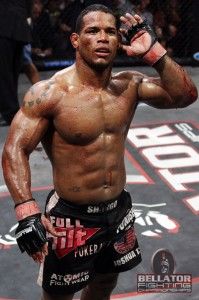


Hector Lombard – Cuba
Hector Lombard is a 4th dan in judo and 2000 Olympian for Cuba, one of the toughest teams in the sport.  Without question, Lombard is one of the most explosive and aggressive fighters in MMA.  Now fighting in the UFC, I believe he will quickly become one of the top contenders in his division.

Lombard fights out of American Top Team in Coconut Creek, FL which is where I once trained before travelling abroad to teach English.  A definite throwback to Mike Tyson, Lombard’s highlight videos are a sight to behold.  Let’s just say he’s better as a friend than a foe.
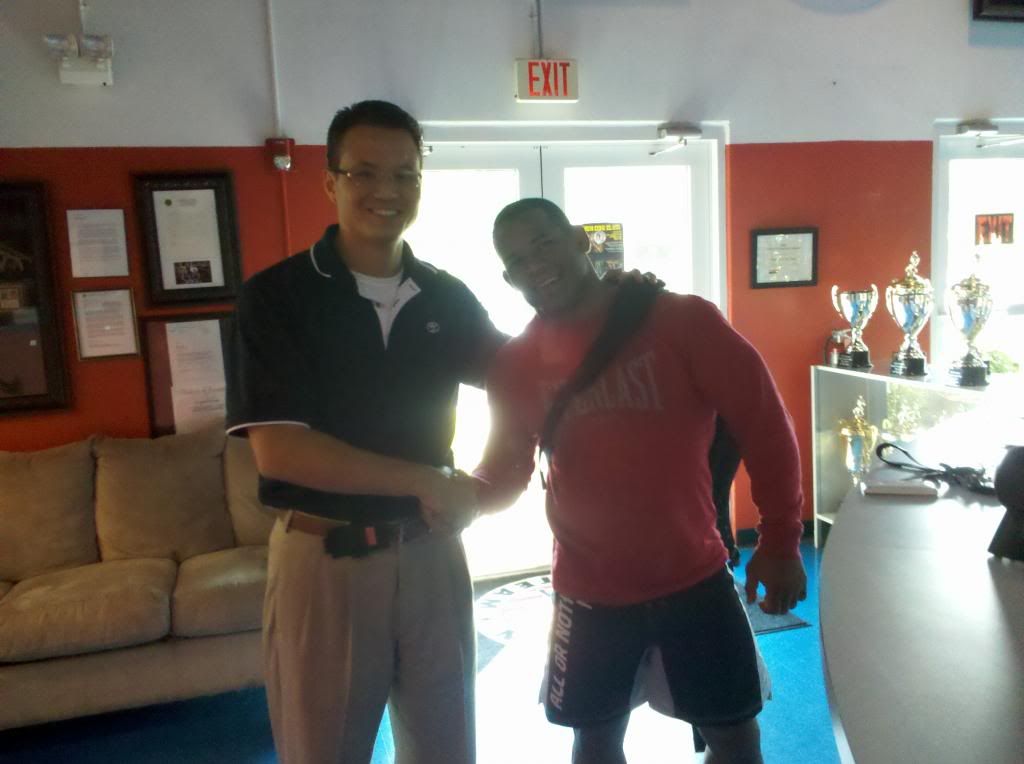

With Hector Lombard at American Top Team

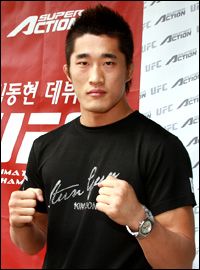
Kim, Dong-Hyun – South Korea
Kim, Dong-Hyun is a former Yong In University judo player.  What does that mean?  It means he is one bad judo dude.  Yong In University is Korea’s official judo and martial arts college and training site for the national team.  Without being too cliché, the “best of the best” in Korea train at Yong In University.  The training intensity he developed at Yong In has translated well into the MMA world.  

Now one of the top contenders in the UFC, Kim is the biggest name in MMA in South Korea.  What’s crazy is I train at his school – Busan Team MAD.  Some great talent coming up in Busan.  Be prepared. 
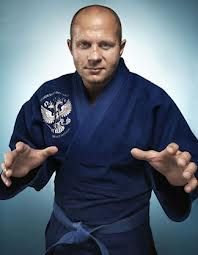

Fedor Emelianenko – Russia
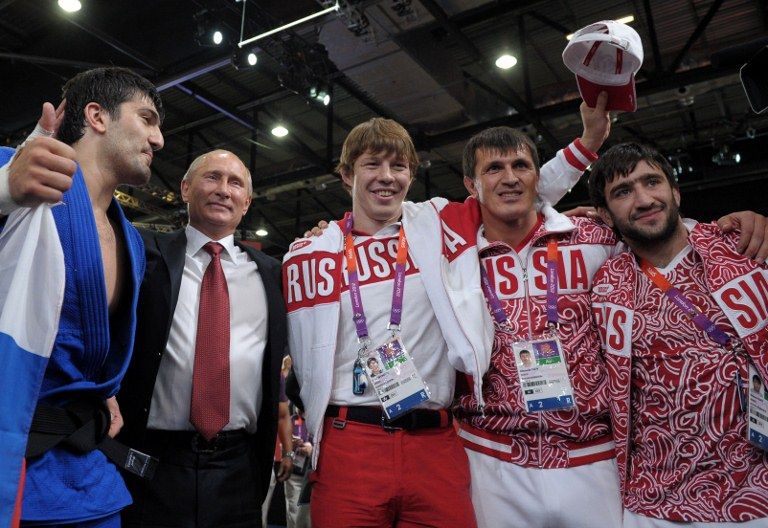
What’s in a name?  I remember watching Fedor’s first fights in Pride back in the day.  When I found out he was a Russian judoka he immediately became my favorite fighter.  Little did I know he would go on to be the most recognizable fighter in the game and responsible for taking MMA to new levels.  A former competitive judoka from Russia, Fedor placed in several top tournaments in Russia.  What’s the big deal about Russia and judo?  Obviously  Japan, France and South Korea don’t have the answer to that question as Russia is arguably the most dominant country in the sport today.  This not including Russia’s “related” countries (e.g. Georgia, Uzbekistan, etc.) that many of us view as part of the empire in northern Asia.  Russia dominated the 2012 Olympic games in judo (finishing first overall) and shows year over year that they bring the pain to the tatamis. 

Fedor is one of their products.  With a very long and brutal career, his days look numbered in MMA.  If he ever finds himself in the ring again it will likely be as a coach or promoter.  After suffering losses at the tail end of his career, it was clear that the abuse from years of fighting and the evolution of the sport have finally caught up with him.  It happens, but has no bearing on the fact that this great judoka was once King of the cage for over a decade.
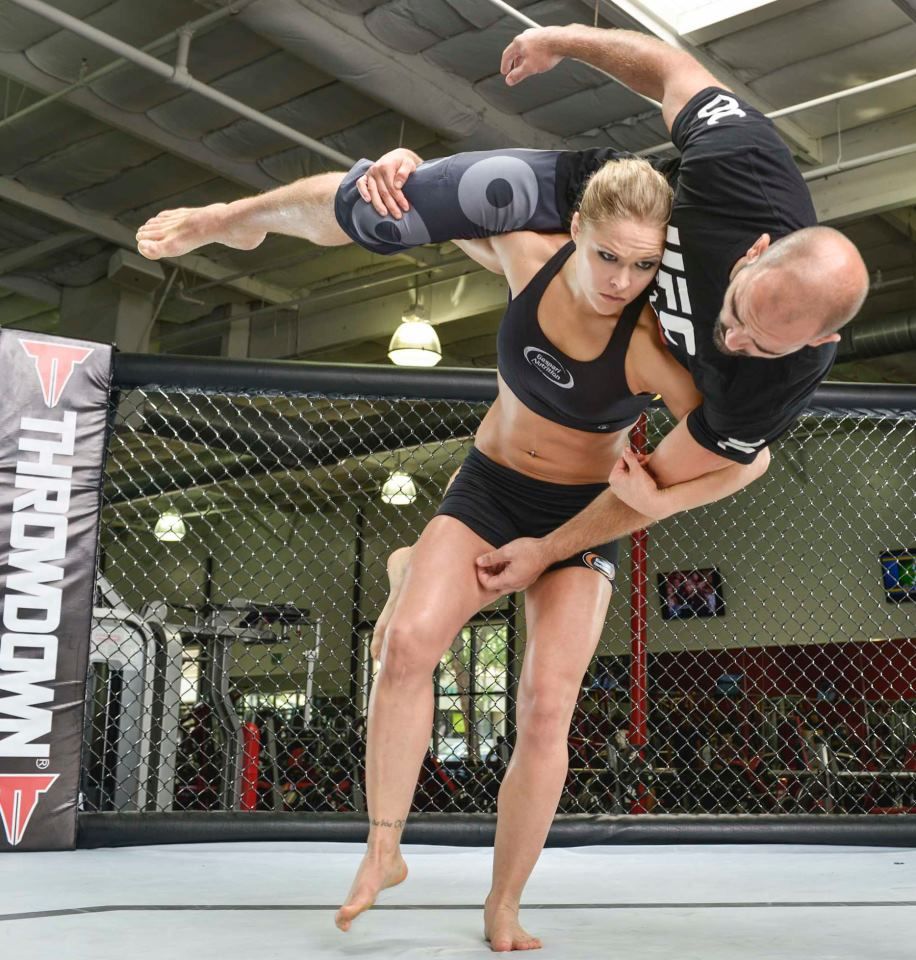

Ronda Rousey – USA
What can I say?  You can’t overlook this girl.  A Jimmy Pedro protégé, Ronda Rousey has made us all watch MMA a little more.  A junior World Champion and medalist at the World Championships and Olympic Games, Rousey is the reason women are in the UFC today.  Her level of play, technical ground game (a la Jimmy Pedro) and ferocity make her unstoppable at the moment.  She is the biggest name in women’s MMA since the sport came about.  Not only is she better looking than the ring girls, but she can turn them all into pretzels as well!

A trash talker and a pretty face, I hope she continues to put judo on the map and bring much needed recognition to all-time great, Jimmy Pedro.
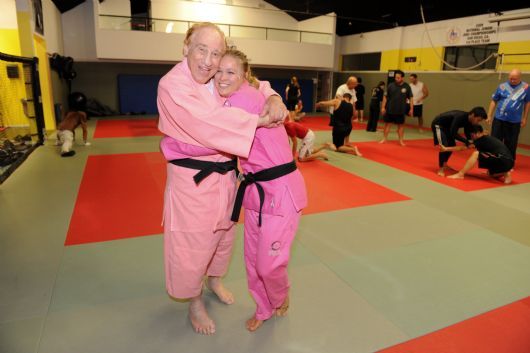
Rousey and "Judo" Gene Lebell


Oss.

Friday, December 14, 2012

What in the World Happened to Judo? The Future of Women's Judo

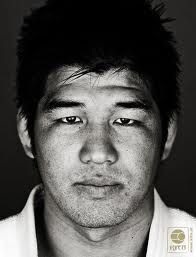
Kosei Inoue - the greatest
Judo is by far one of the most organized and widely practiced martial arts in the world today.  At the 2012 London Olympic Games, 137 countries participated in the event.  That is a true testament to how universal it has become.  And for good reason.  Judo is a sport that can and does appeal to almost everyone.  The physically challenging nature of judo accompanied by it's life-enhancing moral code of conduct, judo can be practiced by anyone of any age.

Judo is typically practiced by men.  It is a combat sport that is not easy on the body and it's style of grace is different than what would be seen in ballet or figure skating - two activities that are equally as grueling.  Because of this, the growth of women's involvement has been slower than for men with the exception of a smaller core group of countries (e.g. France, Brazil, China, Cuba, Korea, Germany, Great Britain, and Japan).  Even within the more successful women's programs, the margin of success is still in favor of the sport's founding country - Japan.


Japan - It's Own Greatest Rival
The new face of judo
All of this reminds me of the sport 20 years ago for men.  Though judo's popularity was spreading rapidly and many countries were developing their own national programs, Japan was still the dominant team.  To beat a Japanese was a very big deal to any country.  Things have changed so much since then.  It's become clear in recent years that Japan is no longer the dominant country, but rather a part of the full spectrum of competitive judo.  In the London Olympics, Japan was fourth at the medal table, securing just a single gold medal and 7 medals in total.  Russia, France, and South Korea were the top teams, respectively, for this Olympic Games.

For many of us who started judo LONG ago, we will all have a soft spot for Japan.  Japan did an outstanding job of streamlining the sport, growing it globally, and making it a dynamic Olympic event.  We all loved seeing the new big name Japanese players dominate competition with their textbook technical proficiency.  So today when we see their top players being defeated regularly in the international venues, I think I can speak for many "older" timers that there's likely a part of us wishing that a new Kosei Inoue is being born in some hospital somewhere in Japan.  Maybe in a far-off mountain temple with ministers of judo chanting in harmony...or something along those lines.  In short, Japan is the reason Japan is not as "successful" competitively as they once were - and we can only thank them for this fact.


The Future for Women's Judo
The future of women's judo
Sharing the limelight shows us how far the sport has really come.  How involved and unique each country is with the techniques.  I believe the same path lies ahead for women's judo.  Though Japan's women did not fare well in London, they typically dominate international events.  Actually, in recent years it's generally been the women that have pulled the overall Japanese team to the top spot.  I think that as time goes on and the sport of judo continues to grow, the level of competition globally will also come up to speed in the women's category.  The playing field will be leveled out just as with the men and we'll see greater game play among a broader scope of countries.

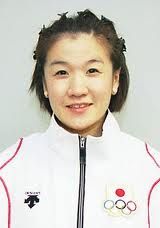
Ryoko Tani Tamura
That being said, the state of women's judo today is nothing short of dazzling.  Women by nature have a tendency to place a greater focus on technique and it shows in competition.  Men's matches at times can appear to be a bit like wrestling - and the Olympics already has that event.  This is judo.  We like to see bodies being whipped to the mat with speed and power.  There's no doubt that women give us that in there display of technical judo.

Here's to the next 20 years for the world of judo.


Monday, December 10, 2012

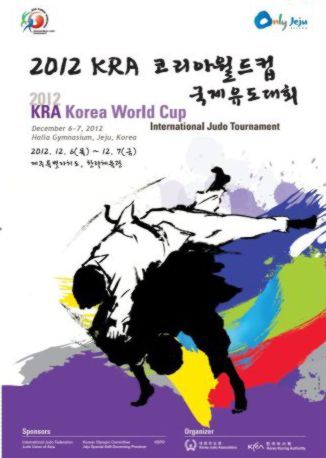
Judo World Cup Jeju (Korea)

This past weekend was the judo World Cup in Jeju, South Korea.  Several countries hold World Cups where competitors from around the world can come and compete.  Coming off the tails of the Tokyo Grand Slam, this event attracted some great talent, though not quite top tier as would a Grand Slam event.

The day before the event, a competitor from Busan came by our school.  He was a young kid, maybe 15 or 16 years old, but already had knobbed up fingers.  Oh judo!  This wasn't the first time that a high level competitor stopped by our school.  On two other occasions that I remember, we had high level players come by for a workout before a big event.  I'm not quite sure why.  It is probably to get the blessing of our master instructor who has been the owner of our school for 30 years.  My school is the most historic in Busan, the second largest city in South Korea and the instructor is well regarded in the judo community.

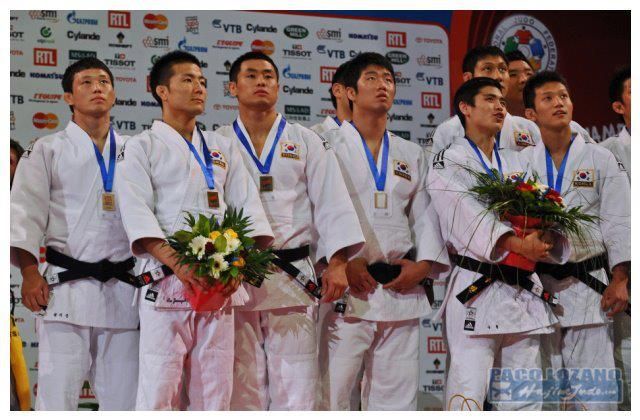
In any event, it's great to see the next generation of potential world class talent come through every few months.  Korea fared well in the tournament but did not take the top spot as a team in the final results.  Coming in second to Japan, Korea still captured 4 gold medals, 10 silvers and 11 bronze medals.

Kim Jae Bum - on top of the judo world
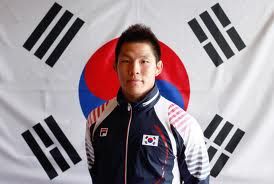
As my instructor said in an interview I had with him, the future of Korean judo (유도) looks brights in the middle and lightweight divisions.  The way it seems to me after training here for a year an a half, he's probably right.  After Korea's performance at the Olympic Games (with the exception of Wang Ki Chun being injured by a juji gatame) I would have to agree.  It's really fun to be this close to one of the strongest judo programs in the world.

Friday, December 7, 2012

Adidas Commercial for the Korean National Judo Team


Being in Korea has rejuvenated my interest and involvement in the sport of judo.  Judo is a big sport and martial art here in Korea.  Anytime a country has a university dedicated to the development of a sport, where one can receive a college degree in THAT sport...you know they're serious.  That's Korea.


Wang Ki Chun & Kim Jae Bum
Yong-in judo mascot
Korea has never stopped producing top athletes in the game, and always bring home gold medals at all levels each year.  Korea's national judo and martial arts university, Yong-in, is also the training ground for the national team which includes Wang Ki Chun, Kim Jae Bum, and Song Dae Nam.  The facility looks unbelievable and there are no corners cut in the preparation for the World and Olympic stage.  I plan on visiting Seoul this winter break and my hope is to have a workout at Yong-in and to see their facilities.  I am almost as excited about the notion as I was when visiting the Kodokan Judo Institute.

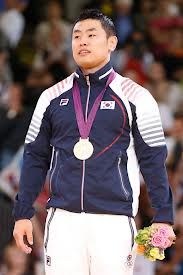
Song Dae Nam, 2012 Gold

I came across this great Adidas commercial (below) for the Korean National Judo Team in training.  Unfortunately, I can't understand what they are saying (I'm a bad Korean!) but the feature is really awesome nonetheless.


These are the top athletes in the game globally.  Wang Ki Chun and Kim Jae Bum are arguably among the best players in history and this video gives a brief glimpse into why.  True professionals.


2012 Olympic Judo Controversy: Ebinuma Masashi (JPN) vs Cho Jun-Ho (KOR)


The 2012 London Olympics is upon us and already it's been marked with numerous memorable and infamous moments.  Being a judoka, I am living in bliss as Korean TV shows all the judo matches with Korean athletes and often all the quarter- and semi-final matches.  The timing is perfect too because judo starts in the early evening and ends right around 1:00 PM.  So I'm off to neva' neva' land with images of judo on my mind!

Korea has done well this Olympics.  South took two golds and North took one.  I tend to count them as one country because...they are one country!  However, South Korea also has one bronze medal which will likely be shrouded in controversy for many years to come.

In the quarter-final match between Cho Jun-Ho of South Korea (KOR) and Ebinuma Masashi of Japan (JPN), the IJF (International Judo Federation) Refereeing Commission overturned two decisions by the referee and judges on the mat during the Golden Score period (or sudden death - first score ending the match).  The first where Ebinuma (JPN) was initially awarded a yuko score for executing a throw on Cho (KOR).  The IJF Refereeing Commission overruled the call and took the score away, thus allowing the match to continue (as the score would've ended the sudden death match).  The second was during the decision on who won the match.  All three judges on the mat voted for Cho (KOR) as the victor, but then the Referee Commission overruled that decision as well.  Needless to say, Korean fans were upset, and much of the judo world was in a state of confusion and disappointment that this happened.

Ebinuma Masashi (JPN)
Cho Jun-Ho (KOR)


How Judging Works in Judo:
Understanding how judging works will help you to understand how this happened.  Not if it was a good call or not, just how.
There are three individuals on the field of play, or tatami mat.  Two sit in chairs at opposite corners of the mat.  They are called "judges".  A third is following the players/fighters, calling the action - they are called a "referee".  These individuals are the primary decision makers of the match, and the vast majority of matches are called by these three.  However, the IJF also has a second set of eyes, if you will, that oversee the decisions of the mat referee and judges.  This second set of eyes is called the "Care System".  The Care System is made up of two cameras set at locations that offer a view different than those of the mat judges.  These cameras are under the control and supervision of two additional individuals.  They are called the "Refereeing Commission" within the Care System.  Most sports have a similar function as the IJF Care System.  It allows for video analysis to ensure fair game play.  This Refereeing Commission very rarely steps in and overrides calls, but in this particular match, it happened twice.

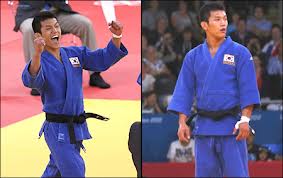
After the initial decision (left)
After the overruling (right)

IJF Official Statement:
In response to the confusion and outcry from the judo community, the IJF issued an official statement regarding the incident(s).  A portion of their statementsis as follows:

"In the quarter final between two fighters (the Japanese, EBINUMA Masashi, and CHO Jun-Ho from the Republic of Korea) during the Golden Score (three minutes sudden death period, where the first score wins) the commission intervened twice. The first time, after checking the video by three experts, to inform the referees that the impact of the projection of the Japanese could not be valued at level 1 (Yuko). A second time, when at the end of Golden Score, the three referees designated the athlete from the Republic of Korea as the winner. Indeed, the commission explained to the referees that the action, which had been recognized as a Yuko and then lowered in value, was nevertheless the strongest action to be taken into consideration."

Essentially, the IJF is explaining why the decision to award Cho (KOR) the win was controversially overturned.

A Pointless Reward:
When a judo match ends with no points scored, or if the score is even, judges will award the win to the player who was more active, showing greater initiative and meaningful attempts to score.  Makes sense.  In this match, it is my opinion that the Korean dominated the play and thus deserved the decision - which he initially received.

There's the rub though.  Was the "action, which had been recognized as a yuko" by Ebinuma (JPN) greater than the dominant play of Cho (KOR)?  The IJF felt it was "the strongest action to be taken into consideration".

I believe it was not.

If Cho (KOR) had not commanded the action as well as he did, I would likely agree with the IJF decision and therefore grant Ebinuma (JPN) the win.

Having said all that, I actually believe that the score by Ebinuma (JPN) deserved to be recognized, which would've therefore given him the win without incident.  I guess this day the IJF just didn't see things the way I did.  But, then again, I wasn't their and this is just one fan's take.

In the end ironically, both players won a bronze medal.  They showed great sportsmanship toward each other in the true style of judo as can be seen in their statements after the match (from Yahoo News):

Ebinuma "I thought I was going to lose but there was all this support in the spectator seats and that allowed me to get this medal"...."but I'm feeling a bit bad for (Cho)."

Cho "Initially I thought I had won but when it was reversed I was a little sad"...."but I had my remaining fights to focus on and I hoped (Ebinuma) would get a good result because he beat me. We both won bronze so I'm happy."

 Osu!


Here's the Video:


Six Pack for Success - USA Judo Coach, Jimmy Pedro

World Champion and USA Coach
Jimmy Pedro
World and Olympic Champion
Kayla Harrison

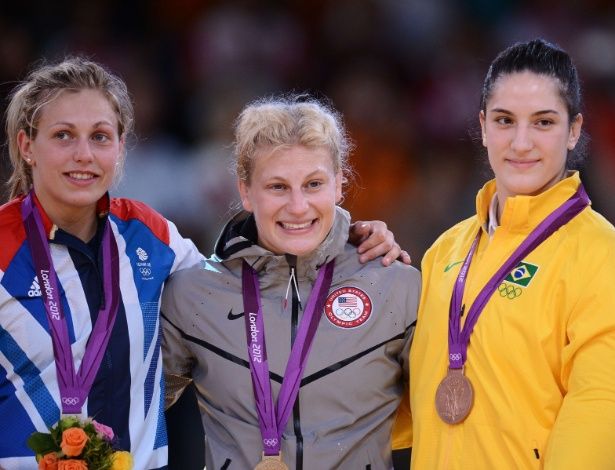
Judo world champion and 2x Olympic medalist Jimmy Pedro made history by coaching the first ever US gold medal player in the sport of judo during the 2012 London Olympic Games - Kayla Harrison.

For as long as I can remember, Jimmy Pedro has been an inspiration to a nation of judokas hoping and praying for an Olympic gold medal.  I've always enjoyed watching and listening to Jimmy speak and coach.  He is an inspiration to anyone who looks at his credentials and attitude - 4 year division I collegiate wrestler with an MBA, most decorated American judo player of all time, most successful American judo coach of all time, and a tremendous natural leader.  His insightful, professional demeanor backed by a world class work ethic and record make him one of my all-time favorite inspirational figures.  He wrote this article as a guide for business leaders to utilize his own recipe for success both on and off the mat.

Suffice it to say, from volunteer to venture capitalist, amateur to pro athlete, you'll benefit from reading the following article:

Coach Jimmy Pedro with Kayla Harrison after winning GOLD!

Six Pack for Success
Entrepreneurs and business leaders juggle a lot of responsibilities. I do, too. But “too busy” is no excuse for sub-par performance.
I had a busy summer, including a pressure-filled two-week “business” trip to London. How did it go? We won gold and bronze medals, the first time a U.S. Olympic Judo Team has had such success, and I was proud to be the coach. As vice president of sales and marketing for Zebra Mats & Outfitters, I lead the company to a revenue milestone, hitting the $10 million mark. And back home in the Boston suburbs, my judo dojo—Pedro’s Judo Center—grew its programs to train an even more diverse group of athletes and judo enthusiasts.
To help me succeed in all this, I relied on a six pack. You should grab one too, and take all six to succeed in business.

1. Create a vision for success

Every business leader should ask, “What do I want to achieve?” From the beginning – especially if you lead multiple projects – you must have a vision of where you want to be someday.
When I started with the development program for U.S. Judo in 2005, my vision was that American Judo would be a world powerhouse by the 2012 Olympic Games. I told the team, “We can compete with the best, and here is what that requires: We’ll be the first team on the training mat and the last off. We’ll work harder than anyone. That’s what it takes to be world champions.”
That’s the vision. And with a company or athletic team, it must be a shared vision. A leader creates the vision that teams can support.

2. Set and document goals

The judo athletes on my team had individual goals, often more than one. The salespeople on my team at Zebra Mats also have multiple goals. These goals make it possible to achieve your vision. One goal must be your ultimate achievement. Then your second and third goals are a bit easier to obtain.
It’s vital to record these goals, then write a tactical plan to reach them. Check in with that plan to make sure you’re doing what’s necessary to reach that ultimate goal.

3. Build the right team

When your sales staff believes in your vision, they’ll work as hard as you to contribute and to keep moving forward. Your team might have people with great skills, but if they don’t believe in your vision, they will not work. One person who doesn’t fit can bring down an entire group, and can bring you down, too.
For our Olympic Judo team, staffing was critical. We had pre-Games training and competition in multiple locations. That environment demanded consistency and team effort. We also had to make tough decisions and remove people from the team who didn’t fit.

4. Make difficult decisions

Whether for personnel issues or budget matters, if you make decisions in line with your vision, the tough ones become easier. Ask yourself, “Does this support the company vision?” When you can confidently answer that question, you can become a fearless decision maker.
This will also help you make decisions quickly. It’s not all about speed, but decisions become more difficult the longer you delay. As soon as you sense a personnel issue is not right, for example, determine your options and their alignment with your vision. Then it’s time to decide.

5. Communicate frequently and effectively

If your team members don’t hear from you often, they’ll think you don’t care, or they’ll assume even worse. Good communication can keep people motivated and working to achieve their goals and your vision.
No, you don’t have to include everyone in each decision. And you don’t have to ask for input all the time. You should, however, communicate your reasons for making decisions.

6. Improve continuously

You’re working hard, but are you getting better everyday? Don’t be complacent with just getting stuff done.
Most importantly, work on your weaknesses. Work on ways to improve personally, and work on making your company stronger. This seems obvious, but know that hard work is not necessarily smart work.

After winning bronze medals in Olympic Judo in 1996 and 2004, Jimmy Pedro set his vision on sales and marketing for Zebra Mats and Outfitters, a $10 million company and the leader in flooring and equipment for the mixed martial arts industry. As coach of the U.S. Olympic Judo team, he lead America to its best world performance ever. Pedro lives in Methuen, Massachusetts, and is a married father of four.
Related Posts Plugin for WordPress, Blogger...